Badge of Quality
We work in alliance with our authorised distributors to deliver products made with VICTREX 450G around the globe
PEEK vs 450G PEEK: Are they the Same?
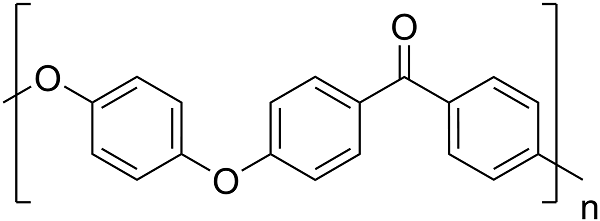
PEEK is a general term, an abbreviation, for the polayaryletherketone (PAEK) polymer [whose full name is poly(oxy-1,4-phenyleneoxy-1,4-phenylenecarbonyl-1,4-phenylene) ] and whose molecular backbone structure is defined by the repeat unit below.
VICTREX PEEK 450G is a specific grade of PEEK polymer, a unique grade which is only made by Victrex and which has a specific range of molecular weight. The molecular weight defines the bulk properties of the PEEK 450G polymer, including its stiffness, strength, toughness, crystallinity and melt processing behaviour.
VICTREX PEEK 150G vs 450G: What's the Difference?
VICTREX PEEK 450G is defined as a standard melt viscosity (MV) PEEK grade, with a medium molecular weight. Other VICTREX PEEK grades are available with higher and lower melt viscosities and higher or lower molecular weights respectively. VICTREX PEEK 150G is a higher flow, lower molecular weight, lower MV grade of PEEK compared to 450G. [A lower melt viscosity, measured in Pa.s, equates to a higher Melt Flow Rate (MFR)]. As a result, 150G may be more suitable for applications where lower viscosity in the melt during processing is desirable, for example, when injection moulding thin-walled parts or long, thin sections with intricate geometries; impregnating carbon or glass fibres for composite prepregs; or adding high levels of solid fibrous or particulate fillers and reinforcements to make compounds. However, the lower molecular weight also changes the bulk properties of the polymer: lower molecular weight PAEKs have higher stiffness and strength combined with reduced toughness, ductility and impact resistance. This is a consequence of the shorter polymer chains, which are less entangled, crystallise more readily and to a greater overall extent. Some of the properties of 450G and 150G are compared in the table below to illustrate these differences.
| Property | Units | Test Method | VICTREXTM PEEK 450GTM | VICTREXTM PEEK 150G |
|---|---|---|---|---|
| Typical values | ||||
| Melt viscosity, 400°C/1000s-1 | Pa.s | ISO 11443 | 350 | 130 |
| Melt flow rate, 380°C/5kg | g/10 min | ISO 1133 | 8.5 | 75 |
| Tensile modulus, 23°C | GPa | ISO 527 | 4.0 | 4.1 |
| Tensile strength, 23°C | MPa | ISO 527 | 98 | 105 |
| Tensile elongation at break, 23°C | % | ISO 527 | 45 | 30 |
| Flexural modulus, 23°C | GPa | ISO 178 | 3.8 | 3.9 |
| Flexural strength, 23°C | MPa | ISO 178 | 125 | 130 |
| Izod impact strength, notched, 23°C | kJ/m2 | ISO 180 | 8.0 | 5.0 |
| Melting point, Tm | °C | ISO 11357 | 339 | 342 |
| Crystallisation temperature, Tc | °C | ISO 11357 | 290 | 296 |
| Degree of crystallinity, typical | % | ISO 11357 | 35 | 39 |